

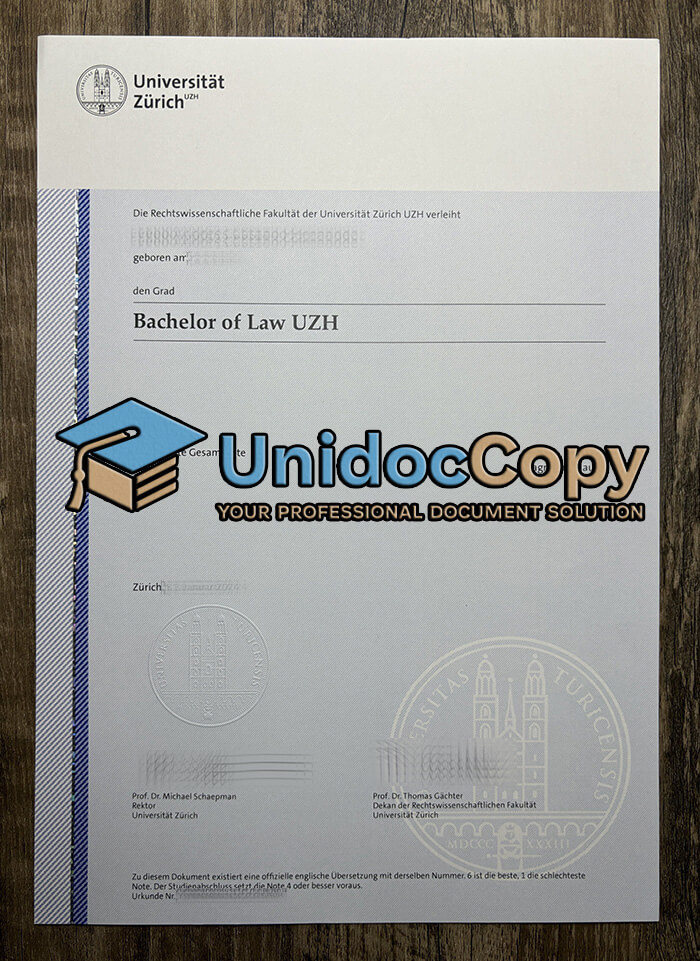
On a hill overlooking the Limmat River, where the Swiss Reformation once reshaped the religious landscape of Europe, Universität Zürich diploma, Replica a Universität Zürich certificate online. an institution that began in 1833 has grown into one of the most influential research universities in the German-speaking world.
The University of Zurich (UZH) was not founded by a monarch, nor by the Church, nor by a papal bull. It was founded by the people—the first university in Europe to be established by a democratic state. That founding principle has shaped the institution for nearly two centuries.
The story of the University of Zurich begins earlier than its official founding date. Its origins trace back to 1525, when the theologian Huldrych Zwingli, a leader of the Swiss Reformation, established a theological college in Zurich. That institution, along with existing colleges of law and medicine, became the foundation on which the modern university was built.
On 29 April 1833, the cantonal government of Zurich merged these three colleges with a new faculty of philosophy, I need a Universität Zürich degree certificate online. creating the University of Zurich—the first university in Europe to be founded by a state rather than a monarch or the Church. The new university was explicitly designed to be different: open to new ideas, independent of religious authority, and accountable to the public it served.

In 1866, the university admitted its first female doctoral student, the Russian student Nadezhda Suslova, who became the first woman to earn a doctorate in a German-speaking country. In 1914, the university moved into its main building on Rämistrasse, designed by the architect Karl Moser, where it remains today.
How do i buy Universität Zürich certificate?
Today, UZH is the largest university in Switzerland, with approximately 28,785 students at the Bachelor’s, Master’s, and Doctoral levels in 2025. It offers the widest range of subjects and courses of any Swiss higher education institution, with over 140 Master’s programmes and 62 Bachelor’s programmes.
Its global standing is reflected in its rankings. In the 2026 Center for World University Rankings, #UZH diploma, #UZH degree certificate online. UZH placed 63rd out of 21,291 universities worldwide, placing it in the top 0.3% of institutions globally and 19th in Europe. It ranks 97th for education, 65th for faculty, and 70th for research. In the 2025 QS World University Rankings, UZH placed 109th globally.
The university has produced or hosted 12 Nobel laureates, including Wilhelm Röntgen (Physics, 1901), Albert Einstein (Physics, 1921), and Erwin Schrödinger (Physics, 1933). Its alumni and faculty include some of the most consequential figures of modern science, and its research strengths span molecular biology, neuroscience, clinical medicine, ecology, and political science.