

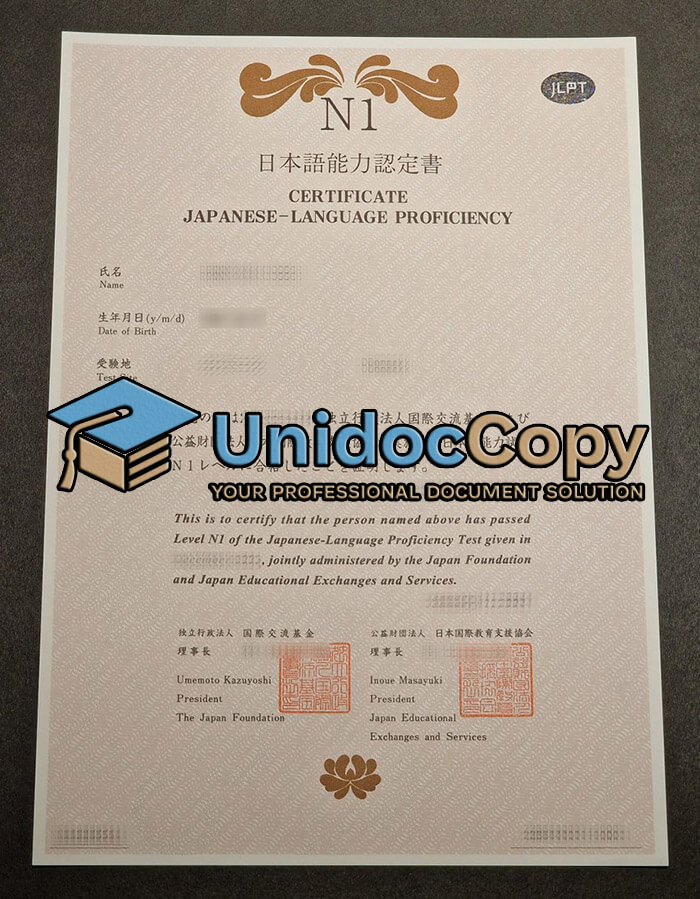
In the landscape of Japanese language education, one credential towers above all others. N1 Japanese certificate. The N1 level of the Japanese Language Proficiency Test (JLPT) is not merely a certificate—it is the gold standard, the definitive proof that an individual has achieved near-native mastery of one of the world‘s most complex and nuanced languages.
For learners who have dedicated years to the study of Japanese—through textbooks, classrooms, conversation practice, and immersion in media and culture—the N1 represents the culmination of that journey. It is the level at which Japanese is no longer a language you study, but a language you inhabit.
According to the official JLPT guidelines, the N1 level certifies that an individual can comprehend “Japanese used in a broad range of scenes in everyday life and in a wide variety of situations”. The detailed breakdown is more revealing: at N1, learners must be able to read newspapers and logical essays, follow the flow of complex arguments, understand the details of narrative content, and follow the intentions of the authors across a wide range of topics.
They must be able to listen to and understand naturally paced conversations, news reports, and lectures across a broad range of scenarios, Get a N1 Japanese certificate online. following the logical structure and details of the content.
In practice, this means that N1 holders can participate in business meetings without a translator, write professional emails and reports in Japanese, read newspapers and novels without a dictionary, and understand nuanced conversations that reference cultural, historical, and political contexts. They are, for all practical purposes, fluent.
The JLPT is divided into five levels: N5, N4, N3, N2, and N1, with N1 being the most advanced. Purchase a N1 Japanese diploma online. The structure is cumulative: each level builds on the knowledge required for the levels below it. The N5 and N4 levels test the basics: classroom Japanese, simple conversations, and reading materials of several hundred characters . N3 serves as a bridge between beginner and advanced levels, introducing more complex grammar, kanji, and longer reading passages.
The N2 level, already considered a significant achievement, certifies comprehension of Japanese used in everyday situations and in a variety of workplace contexts. Many employers and universities accept N2 as proof of sufficient Japanese proficiency for study or employment. But N1 is different. N1 is what sets apart the serious professional from the competent learner.