


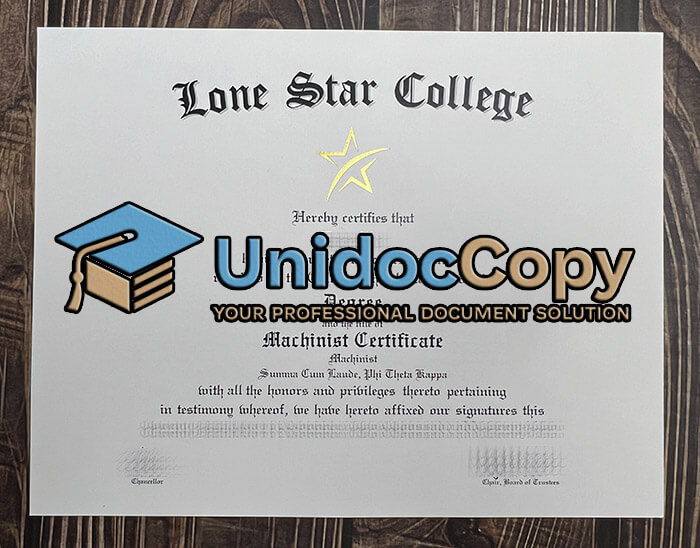
In the sprawling landscape of Greater Houston, where energy, Lone Star College diploma, Replica Lone Star College certificate online. healthcare, and aerospace industries converge, an institution that began in a high school gymnasium in 1973 has grown into the largest institution of higher education in the region.
The Lone Star College System today serves more than 90,000 students each semester across eight colleges, multiple satellite centers, and two University Centers. Its story—from a single-campus district to a multi-college system with an annual enrollment that would place it among the nation’s largest universities—is a testament to the power of accessible, affordable public education.
The college’s origins are rooted in community determination. In 1972, residents of the Aldine, Humble, and Spring Independent School Districts voted to form a Union Junior College District. The following year, the North Harris County College opened its doors with 613 students and a sixteen-member staff, holding its first classes in Aldine High School.
Over the following decades, the district expanded as more school districts joined, and enrollment surged. Can i get to buy Lone Star College degree? In 2008, after a community-wide polling process involving more than 5,000 participants, the institution was renamed Lone Star College. The name was chosen to reflect the system’s broader identity and its service to the greater Houston area.
Today, the college system comprises eight main campuses: LSC–CyFair, LSC–Houston North, LSC–Kingwood, LSC–Montgomery, LSC–North Harris, LSC–Online, LSC–Tomball, and LSC–University Park, alongside more than twenty satellite centers. Its service area spans more than 2,700 square miles with a total population of 2.7 million residents.
Where can i get to buy Lone Star College certificate?
In 2025, Lone Star College earned the Star Award from the Texas Higher Education Coordinating Board—the only community college recognized in the student success category. This recognition reflects years of strategic, data-driven initiatives that have increased student persistence and credential attainment while narrowing equity gaps.