
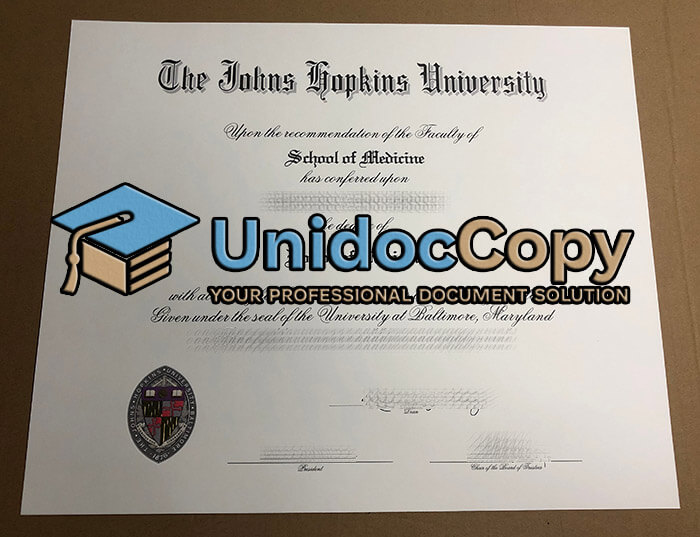
In the heart of Baltimore, where Charles Street meets the intellectual energy of a city rich in American history, Johns Hopkins University diploma, Johns Hopkins University certificate. an institution that began with a revolutionary idea has spent nearly 150 years changing the very definition of higher education.
Johns Hopkins University was founded in 1876, the product of a $7 million bequest from a Quaker merchant and financier who had a vision for something America had never seen. The university was incorporated in 1867, and instruction began in 1876 with Daniel Coit Gilman as its first president.
Gilman’s inaugural address, delivered on February 22, 1876, set the tone for American higher education for the century to come. The significance of the occasion was underscored by the setting: the Academy of Music at Howard and Centre streets in Baltimore, with the governor of Maryland, the mayor of Baltimore, and representatives of a number of colleges and universities among the distinguished guests. “We may say that the university’s birth takes place today,” declared Reverdy Johnston Jr., chairman of the executive committee of the new university’s board of trustees. “I do not think it mere sentiment should we dwell with interest upon its concurrence with the centennial year of our national birth”.
What Gilman created was something unprecedented in America: a university dedicated not merely to the transmission of existing knowledge but to its creation. Johns Hopkins became the first university in the United States to embrace the German model of graduate education, Replica Johns Hopkins University degree certificate. emphasizing research, original scholarship, and the integration of teaching with discovery.
This was a radical departure from the undergraduate-focused, moral-training institutions that dominated American higher education. It is no exaggeration to say that Johns Hopkins invented the modern American research university.
The man who made it all possible, Johns Hopkins, was a Baltimore merchant and financier of Quaker upbringing who never attended university himself. Yet he understood that the future of the nation depended on the cultivation of knowledge. His will bequeathed $7 million—an enormous sum in the 19th century—for the establishment of both a university and a hospital, with instructions that they were to be integrated in ways that would advance both research and patient care.
What Johns Hopkins did not specify was how the university should be organized. This ambiguity became a gift. The trustees, recognizing that the selection of the first president would be central to the shape the university would take, consulted widely.
They read extensively on educational issues, visited universities in the United States and Europe, and sought the counsel of three distinguished university presidents: Charles W. Eliot of Harvard, Andrew D. White of Cornell, and James B. Angell of the University of Michigan. Once the trustees formed an idea of what Johns Hopkins was to become, they knew what sort of president was needed. On December 29, 1874, the Board met with Daniel Coit Gilman and elected him first president the following day. Novelty Johns Hopkins University degree online.
Gilman’s inaugural address echoed the bequest of Edward Hopkins, a colonial governor whose 17th-century gifts to Harvard still kept his name alive. “So may the name of our founder live for more than two hundred years to come, and his gifts be immortal,” Gilman declared. “Johns Hopkins might have used the very words of Edward Hopkins, who desired to bestow ‘some encouragement for the breeding up of hopeful youths, for the public service of the country in future times'”.