
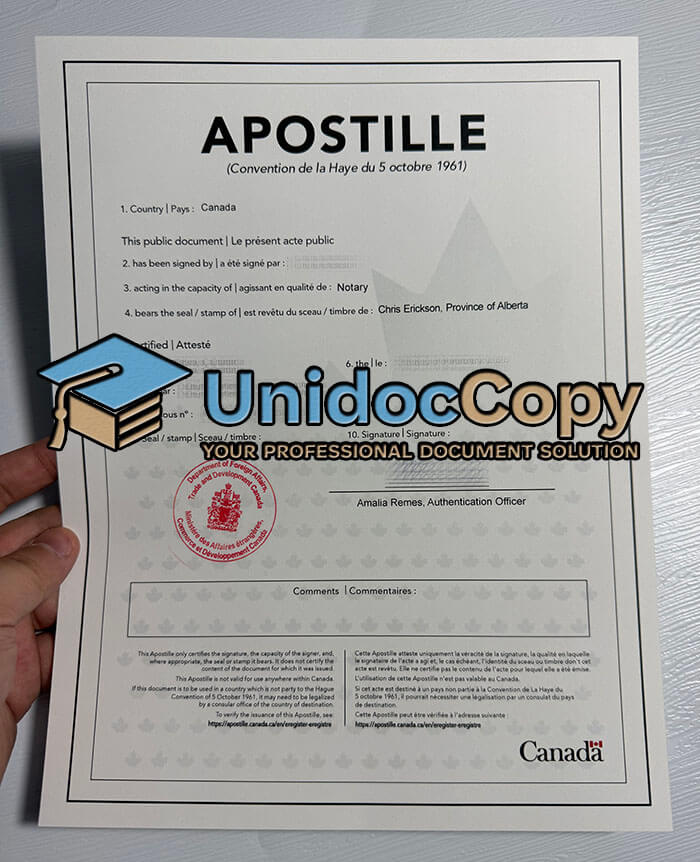
In a landmark move that fundamentally transformed how Canadian documents are recognized internationally, Apostille Canada certificate, Get a Apostille Canada diploma online. Canada officially joined the Hague Apostille Convention on January 11, 2024.
This historic accession eliminated the complex, time-consuming, and costly multi-step legalization process that previously required consulate and embassy approvals. Today, a single Apostille certificate suffices to authenticate Canadian public documents for use in over 125 member countries—including the United States, the United Kingdom, Australia, Germany, France, Japan, and China.
Where can i get to buy Apostille Canada degree?
This guide provides a comprehensive overview of Canada‘s Apostille system as it operates in 2026, covering the step-by-step process, competent authorities, eligible documents, costs, processing times, and critical updates for the ongoing transition period.
An Apostille is a specialized certificate issued by a designated competent authority that authenticates the origin of a public document. How to order a Apostille Canada certificate online? It verifies the authenticity of the signature, the capacity in which the person signing the document has acted, and the identity of the seal or stamp the document bears. Importantly, an Apostille does not validate the content of the document—only its formal origin.
The Apostille is governed by the Hague Convention of 5 October 1961 Abolishing the Requirement of Legalisation for Foreign Public Documents, an international treaty now adopted by 129 countries and jurisdictions worldwide. By joining this convention, Canada aligned itself with a streamlined, globally recognized standard for cross-border document recognition.
Prior to January 11, 2024, Canadians needing to use documents abroad faced a burdensome process known as “chain authentication” or “consular legalization.” A typical document might require:
Notarization by a local notary public
Authentication by the relevant provincial authority
Authentication by Global Affairs Canada
Legalization by the embassy or consulate of the destination country
This process could take four to six weeks or longer and cost
300
300to500 per document. Each step introduced potential delays, fees, and logistical complications. For families preparing immigration applications, businesses pursuing international contracts, or students seeking overseas education, this represented a significant barrier.
Under the Apostille system, the same document now requires just two steps: notarization (if required) followed by Apostille issuance from a single competent authority. Processing times have fallen to 3-10 business days for standard service, with expedited options available in some jurisdictions. Costs have decreased to approximately $50-75 per document.