
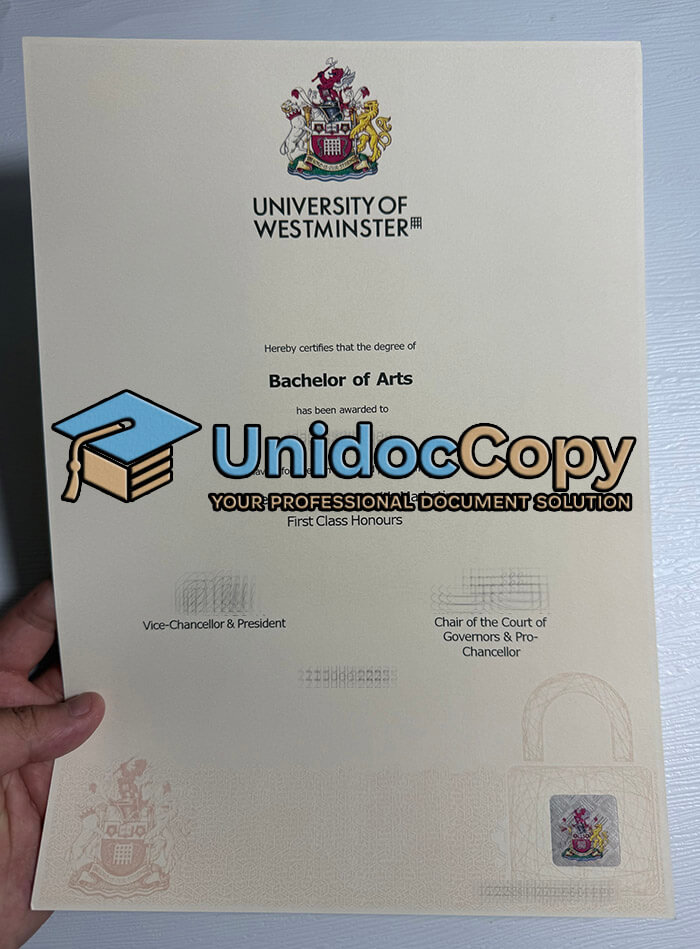
On London’s iconic Regent Street, in a building that once housed the world’s first permanent projection theatre, University of Westminster diploma, Get a University of Westminster certificate online. an institution with a remarkable legacy has been breaking barriers for nearly two centuries.
The University of Westminster was founded in 1838 as the Royal Polytechnic Institution, London’s first polytechnic, with a radical mission: to provide practical, scientific, and technical education to ordinary working people at little expense.
Today, that pioneering vision has evolved into a comprehensive public research university of approximately 19,000 students, with four campuses in central London and Harrow, a global reputation for media, business, and social sciences, and a commitment to diversity and inclusion that remains as vital as it was in 1838.
The story of Westminster is a story of innovation, resilience, and unwavering commitment to access. How to order a University of Westminster certificate online? The Royal Polytechnic Institution opened at 309 Regent Street on 6 August 1838, offering lectures, demonstrations, and working models to “the Public, at little expense,” who could acquire “practical knowledge of the various arts and branches of science connected with manufactures, mining operations and rural economy”.
The Polytechnic quickly became a hub of public entertainment and scientific education. In 1841, the first public photographic portrait studio in Europe opened on its roof. In 1848, a purpose‑built theatre was added, where audiences witnessed the now‑famous “Pepper’s Ghost” illusion, an effect that has endured in popular culture ever since.
On 21 February 1896, the Regent Street Cinema hosted the first performance of a moving film (Cinématographe) to a paying UK audience, delivered by the Lumière brothers. For this reason, the cinema has been described as “the birthplace of British cinema”.
In 1881, the Polytechnic was at risk of closure. I need a University of Westminster diploma online. It was rescued by Christian philanthropist Quintin Hogg, who acquired the lease and reopened the institution in 1882. Hogg expanded the programme of classes, including science, engineering, and art, and created a scheme of technical and trade education in conjunction with the City and Guilds of London Institute.
This commitment to providing education for working people—including evening classes for young Londoners who could not attend university during the day—remains the university’s founding ethos.