

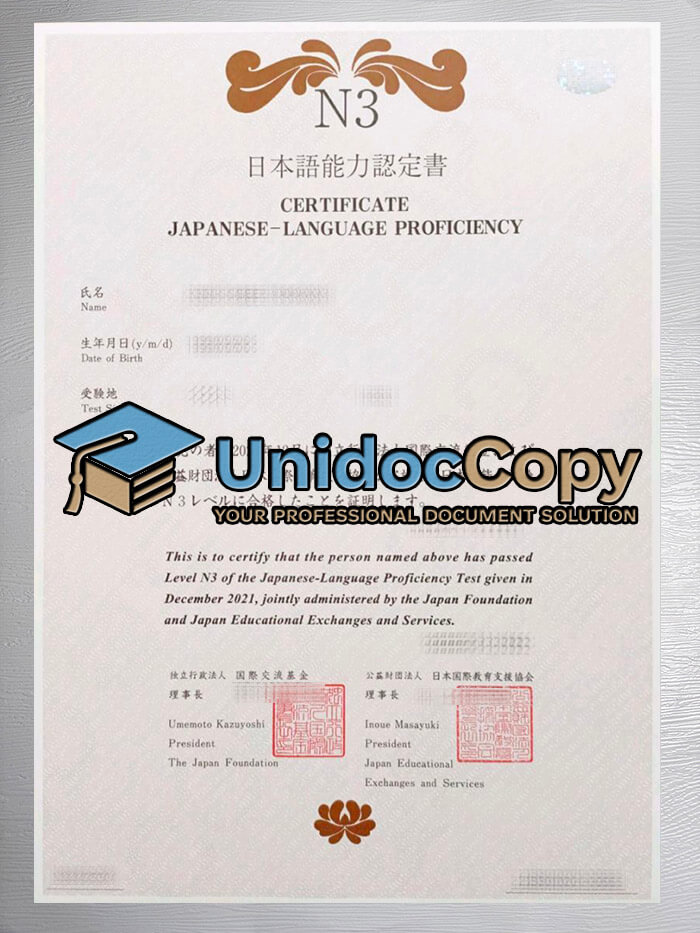
In the landscape of Japanese language proficiency, the N3 level of the Japanese Language Proficiency Test (JLPT) occupies a uniquely strategic position. Get a N3 Japanese certificate online, Purchase a N3 Japanese degree online. It is the bridge—the level that separates basic survival Japanese from the genuine fluency required for work, study, and deep cultural engagement.
N3 is neither beginner nor advanced; it is the intermediate level where the foundational structures are mastered, and the learner begins to engage with authentic Japanese materials without constant reliance on a dictionary.
According to the official JLPT guidelines, the N3 level certifies the ability to comprehend “Japanese used in everyday situations to a certain degree”. The detailed description is more revealing: at N3, learners can read slightly difficult written materials such as short newspaper articles and commentaries, understand the main points of the content, and grasp the flow of arguments. They can listen to and understand naturally paced conversations, news reports, and lectures, follow the main points, and understand the relationships among speakers.
In practice, this means N3 holders can navigate most daily situations with confidence: ask for and understand detailed directions, Where to buy N3 Japanese diploma online? describe symptoms to a doctor, discuss their hobbies and interests, and read graded readers without difficulty.
They can follow the plot of a anime or drama with occasional pauses, and they can read websites and blogs with the help of a dictionary. They are, in the words of many learners, “comfortably intermediate.”
N3 is a genuine milestone. For learners who have passed the N4 level, N3 is the next logical step—but it is a significant step. N3 requires approximately 1,000 kanji and 3,000 vocabulary items, compared to N4’s 300 kanji and 1,500 vocabulary items. Obtain a N3 Japanese certificate online. The grammar required for N3 is also substantially more complex, including passive, causative, and honorific forms, as well as sentence connectors that express logical relationships such as concession and condition.
For learners who have studied Japanese for two or three years—through classroom instruction, self-study, or immersion in Japan—N3 is the level that begins to feel like genuine progress. At N3, learners can begin to engage with authentic materials: newspaper headlines, short articles, and excerpts from novels. They can watch news programmes and understand the main stories. They can have conversations with native speakers on familiar topics without excessive strain.